Society
Captagon cartels, weapons pipelines threaten Jordan and the Gulf
Iranian-linked smuggling networks are weaponizing the Captagon trade, threatening Jordan's borders, Gulf security and regional stability through narcotics trafficking and armed violence.
By Al-Fassel |
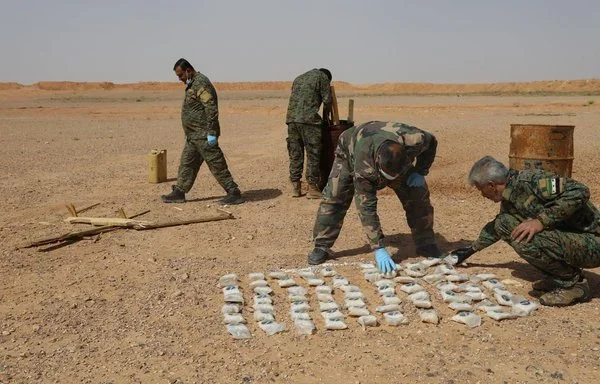
The expanding Captagon trade has emerged as a serious security challenge for Jordan and the Gulf, combining organized crime, weapons smuggling and regional political instability.
Behind this lucrative industry, investigators have identified networks connected to Syria's former regime, Lebanese Hizbullah and Iranian-backed militias operating across the Levant.
Although direct Islamic Revolutionary Guard Corps (IRGC) control remains difficult to establish publicly, evidence increasingly points toward Iranian-linked networks exploiting the narcotics trade.
A multibillion-dollar criminal enterprise
Captagon, an amphetamine-type stimulant, became one of Syria's most profitable illicit exports during Bashar Assad's rule.
The World Bank estimated that Syrian-origin Captagon generated as much as $5.6 billion in annual market value between 2020 and 2023.
US Treasury officials have identified Hizbullah-linked traffickers and Syrian regime associates among those profiting from production and distribution.
Iranian regime's regional relationships provide an established network of armed partners, logistical intermediaries and commercial facilitators.
Analysts have identified pro-Iranian factions in Syria and Iraq as potential contributors to regional smuggling and destabilization.
These networks threaten Jordanian sovereignty while creating lucrative opportunities for organizations seeking financing outside conventional financial systems.
The consequences extend beyond criminal profits, particularly as Saudi Arabia and other Gulf countries remain major destination markets.
Cheap stimulants and counterfeit Captagon tablets threaten public health, addiction prevention efforts and the social stability of vulnerable communities.
Weapons, drones and Jordan's northern front
Jordan faces the most immediate physical threat along its extensive border with Syria.
Armed smugglers have repeatedly attempted crossings using automatic weapons, vehicles and drones carrying narcotics.
Jordanian authorities have also reported encounters involving sophisticated weapons and increasingly aggressive smuggling tactics.
In January 2024, Jordanian forces confronted armed smugglers, killing five suspects and arresting 15 others.
Authorities seized 627,000 Captagon pills, substantial quantities of hashish and an assault rifle during the operation.
Washington Institute analysts reported 194 infiltration attempts between January and August 2023, including 88 involving drones.
Jordan's military subsequently reported confronting armed smuggling groups during additional operations in January and March 2025.
In May 2026, the armed forces reported intercepting 18.9 million narcotic pills and 89 drones during 2025.
These developments demonstrate how narcotics trafficking increasingly intersects with organized armed violence and sophisticated cross-border infiltration.
Jordan cannot confront this threat alone, particularly when criminal networks operate across multiple national jurisdictions.
Stronger intelligence sharing, coordinated interdiction and financial investigations are essential to disrupting these networks.
The international community should support Jordan's border guards and security institutions while strengthening cooperation with Gulf partners.
Protecting regional stability requires confronting both the criminal organizations moving these shipments and the political networks enabling their operations.